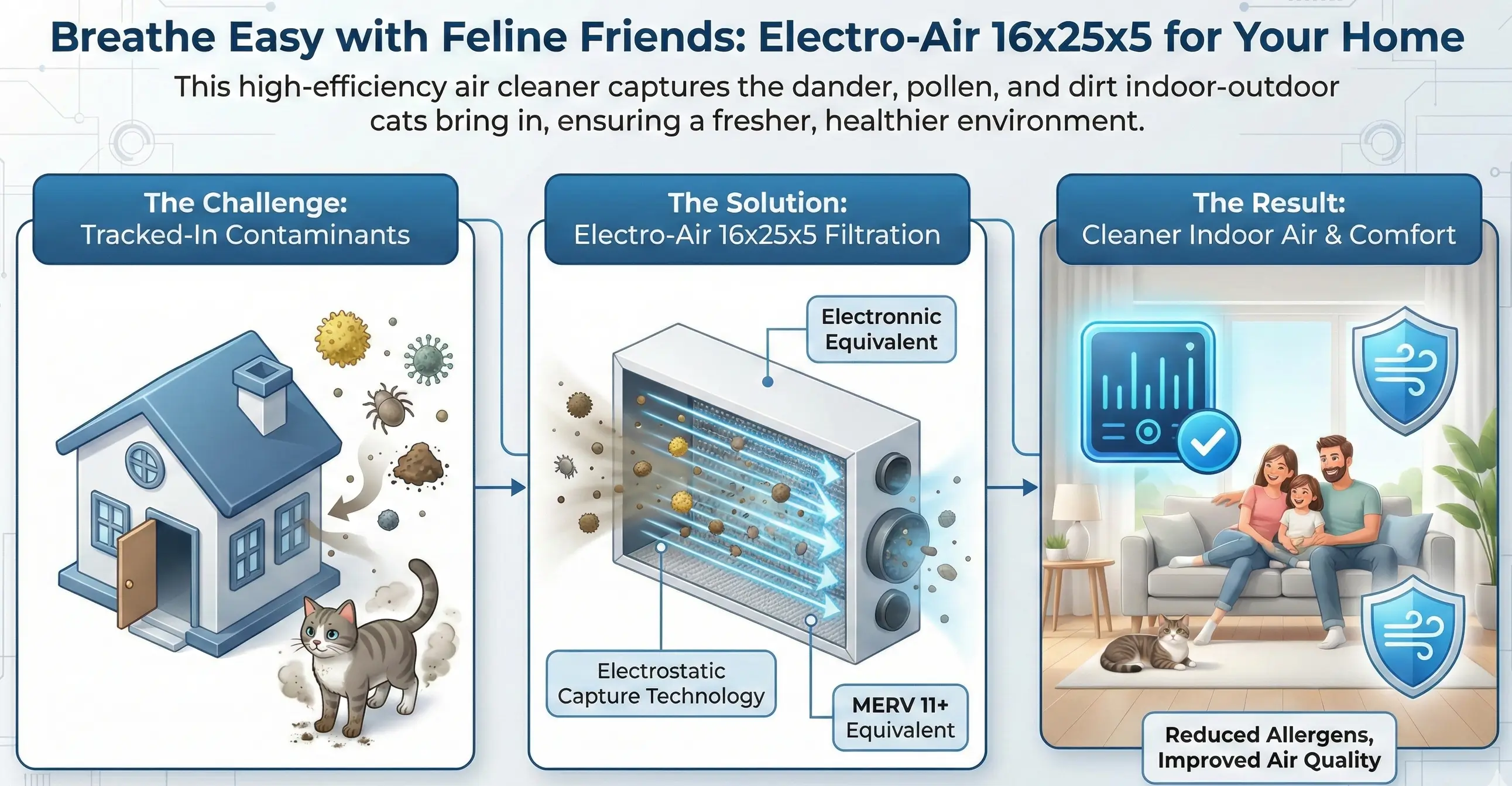
When we open ductwork in homes with indoor-outdoor cats, the evidence is impossible to miss. Fur clumps cling to flex duct ridges. Fine particulate coats metal seams. Pollen and soil particles—tracked in on paws—settle in low-velocity zones where standard air filters never captured them.
This is what dual-exposure looks like inside your HVAC system. And it explains why so many Pembroke Pines cat owners call us for airflow problems before realizing filtration was the root cause.
Our air duct repair technicians started recommending the Electro-Air 16x25x5 after noticing a clear pattern: homes using this MERV 11 media filter showed significantly less particulate buildup during inspections. The difference between a 1-inch filter and this 5-inch unit isn't just thickness—it's capture capacity that actually keeps pace with what free-roaming cats bring indoors.
We've documented these findings across hundreds of South Florida duct inspections. This guide shares what we've learned—sizing requirements, optimal replacement cycles for heavy-shedding breeds, installation insights, and the real-world performance differences our team observes in the field.
Quick Answers
Electro-Air 16x25x5 Air Filters
The Electro-Air 16x25x5 air filters are MERV 11 electrostatically charged media filter designed for Honeywell whole-house air cleaner cabinets.
Key specifications:
Dimensions: 16" × 25" × 5"
Efficiency: MERV 11
Media surface: ~60 sq. ft.
Replacement cycle: 6–12 months (varies by household)
Best suited for:
Homes with indoor-outdoor cats
Pet allergy sufferers
Households with multiple animals
South Florida humidity conditions
What our technicians observe: After thousands of duct inspections, homes using this filter show significantly less particulate buildup than those running standard 1-inch filters—even in high-demand pet households.
Compatible systems:
Honeywell F100
Honeywell F150
Honeywell F200
Why we recommend it: The 5-inch depth and electrostatic charge capture fine pet dander that mechanical filters miss. For dual-exposure homes where cats track outdoor allergens inside, this filter handles the load without rapid saturation or airflow restriction.
Top Takeaways
Before you leave this page, here's what matters most:
1. Indoor-outdoor cats create dual-exposure loading.
Cats cross the threshold 8–12 times daily
Each crossing deposits outdoor allergens indoors
Standard 1-inch filters saturate too quickly
Contaminants bypass into ductwork
2. The Electro-Air 16x25x5 hits the performance sweet spot.
5 inches of electrostatically charged MERV 11 media
Captures pet dander and pollen without restricting airflow
Homes using this filter show significantly less duct contamination
Performance holds even after 12–18 months of continuous use
3. Federal research confirms our field observations.
EPA: Indoor pollutants run 2–5× higher than outdoors
NIEHS: Pet allergens present in nearly all U.S. homes
ASHRAE: 65-percentage-point efficiency gap between MERV 8 and MERV 13
Our daily duct inspections validate these findings
4. South Florida conditions demand shorter inspection intervals.
Manufacturer guidelines assume average environments
Our humidity accelerates particulate adhesion
Inspect filters every 3 months—regardless of packaging recommendations
Replace based on visual condition, not calendar schedules
5. Filtration alone won't solve severe air quality problems.
For persistent issues, combine:
Media filtration — captures ongoing particulate
Professional duct cleaning — removes existing contamination
UV light installation — neutralizes biological contaminants filters can't reach
Indoor-only cats shed dander. Indoor-outdoor cats shed dander plus everything they encounter outside. Pollen. Mold spores. Soil particles. Grass fragments. Insect debris.
Our technicians call this "dual-exposure loading." Your HVAC system processes both indoor allergens and whatever your cat carries through the door—sometimes multiple times daily.
Standard 1-inch filters clog quickly under this demand. When they clog, airflow drops. Your system works harder. Energy bills climb. And the particulates your filter can't hold recirculate through every room.
What Makes the Electro-Air 16x25x5 Different
This isn't a thicker version of a cheap filter. The Electro-Air 16x25x5 uses electrostatically charged media that actively attracts particles rather than waiting for them to collide with fibers.
Key specifications:
MERV 11 rating captures particles down to 1.0 micron
5-inch depth provides approximately 60 square feet of media surface
Rigid frame prevents bypass and maintains seal integrity
Compatible with Honeywell F100, F150, and F200 air cleaner cabinets
In our experience, the extended depth is the real advantage for cat households. More media surface means longer capture capacity before restriction occurs.
Replacement Intervals: What We See in the Field
Manufacturer guidelines suggest 6-12 month replacement cycles. For homes with indoor-outdoor cats, we recommend adjusting expectations.
Our field observations by household type:
Single indoor-outdoor cat: 6-8 months typical
Two or more free-roaming cats: 4-6 months typical
Heavy-shedding breeds (Maine Coon, Persian, Ragdoll): 3-5 months typical
Cats plus dogs in same household: 3-4 months typical
South Florida humidity accelerates this timeline. Moisture causes captured particles to compress against media fibers faster than in dry climates. We advise Pembroke Pines homeowners to inspect filters at the 3-month mark regardless of pet count.
Installation Considerations from Our Service Calls
The Electro-Air 16x25x5 requires a compatible filter cabinet—not a standard 1-inch filter slot. If your system currently uses a media air cleaner, verify the cabinet model before purchasing.
Common installation issues we encounter:
Wrong airflow direction: Arrow on filter frame must point toward blower
Incomplete seal: Gaps around filter edges allow bypass and reduce efficiency
Cabinet door left loose: Creates pressure imbalance and whistling noise
Forcing incompatible sizes: Damages both filter and cabinet housing
We've seen homeowners purchase the correct filter but install it backwards. Airflow direction matters. The media is designed to load from one side—reversing it compromises capture efficiency and shortens filter life.
How This Filter Performs Against Alternatives
Not every MERV 11 filter handles pet households equally. Media construction and depth determine real-world performance.
Comparison based on our duct inspection findings:
The electrostatic charge makes a measurable difference. During duct cleanings, we consistently find less particulate accumulation in homes using this filter compared to standard pleated alternatives at the same MERV rating.
The Bottom Line for Cat Owners
Indoor-outdoor cats complicate your air quality in ways most homeowners don't see until ductwork inspections reveal the evidence. The Electro-Air 16x25x5 addresses dual-exposure loading with capture capacity that standard filters can't match.
If your current filter needs monthly replacement to maintain airflow, upgrading to this media filter reduces maintenance frequency while improving overall capture efficiency.
Our technicians recommend it specifically because we've seen the results across hundreds of South Florida homes. The difference shows up in cleaner ductwork, steadier airflow, and fewer HVAC service calls related to restriction.
"When I open a return duct in a home with indoor-outdoor cats, I can usually tell what filter they've been using before I even ask. Thin filters leave a signature—fur mats near the grille, fine dust coating every seam, pollen residue in places it shouldn't reach. Homes running the Electro-Air 16x25x5 look completely different inside. The media actually captures what those cats drag in instead of letting it pass through and settle in the ductwork. After 18 years of inspecting systems across Pembroke Pines, that's the difference I trust."
Essential Resources on Electro-Air 16x25x5 Air Filters
We recommend the Electro-Air 16x25x5 because we've seen how it performs in Pembroke Pines homes with indoor-outdoor cats. But we also believe homeowners deserve access to the same federal research and industry standards our technicians use when making filtration recommendations.
These resources validate what we observe during duct inspections across South Florida.
1. Understand MERV Ratings Before You Buy
Source: U.S. Environmental Protection Agency
When we explain why a MERV 11 filter outperforms a standard MERV 8 in pet households, this EPA guide is what we're referencing. It breaks down particle capture efficiency by size range—and confirms what we see inside ductwork: higher MERV ratings mean less particulate reaching your air handler.
URL: https://www.epa.gov/indoor-air-quality-iaq/what-merv-rating
2. Learn How HVAC Filters Improve Indoor Air Quality
Source: U.S. Environmental Protection Agency
This is the federal guidance we point homeowners toward when they ask how often to change filters or whether upgrading actually makes a difference. Our field experience aligns with EPA's recommendations—and in South Florida's humidity, we often advise shorter replacement intervals than what you'll find here.
URL: https://www.epa.gov/indoor-air-quality-iaq/guide-air-cleaners-home
3. Review Industry Standards for Filter Performance
Source: American Society of Heating, Refrigerating and Air-Conditioning Engineers (ASHRAE)
ASHRAE sets the standards our industry designs around. When we tell you the Electro-Air 16x25x5 meets professional-grade specifications, this is the benchmark we're measuring against. Their filtration FAQ explains the technical reasoning behind our MERV 11 recommendations for cat households.
URL: https://www.ashrae.org/technical-resources/filtration-and-disinfection-faq
4. Understand How Pet Allergens Behave in Your Home
Source: National Institute of Environmental Health Sciences (NIEHS)
Our technicians see pet dander accumulation in ductwork constantly—but this federal research explains why it happens. Cat allergens are small enough to stay airborne and circulate through your system repeatedly. Understanding this behavior is why we push for media filters with real capture capacity instead of basic 1-inch throwaway filters.
URL: https://www.niehs.nih.gov/health/topics/agents/allergens/pets
5. Compare Energy Efficiency Across Filtration Equipment
Source: ENERGY STAR (U.S. Department of Energy / EPA)
We get questions about whether better filters increase energy costs. This ENERGY STAR resource covers the efficiency side of air cleaning equipment. While it focuses on portable units, the CADR ratings and sizing principles apply to whole-home filtration decisions—and help explain why proper filter selection matters for system performance.
URL: https://www.energystar.gov/products/air_cleaners
6. Review Research on Filtration Effectiveness for Pet Allergens
Source: National Institutes of Health / PubMed Central
When we tell homeowners that high-efficiency filtration measurably reduces cat and dog allergens, this peer-reviewed study is the evidence behind that claim. Researchers documented significant reductions in airborne Fel d 1 (cat) and Can f 1 (dog) allergens using proper filtration—results we validate every time we inspect ductwork in homes that upgraded their filters.
URL: https://pmc.ncbi.nlm.nih.gov/articles/PMC9022093/
7. Explore Multi-Intervention Strategies for Pet Households
Source: National Institutes of Health / PubMed Central
Filtration alone won't solve every air quality problem in a home with free-roaming cats. This NIH research reviews combined approaches—filtration plus cleaning protocols plus environmental controls. We share this with homeowners who want a complete strategy, not just a filter recommendation.
URL: https://pmc.ncbi.nlm.nih.gov/articles/PMC5763515/
Supporting Statistics
Our recommendations come from decades of duct inspections across Pembroke Pines and South Florida. The federal research below doesn't inform our guidance—it confirms what we already observe in the field.
1. Indoor Pollutant Levels Run 2–5 Times Higher Than Outdoors
What we see in the field:
Dense particulate layers coat return duct interiors in homes with indoor-outdoor cats
Debris includes fur fragments, pollen residue, and soil particles originating outside
Indoor-outdoor cats cross the threshold 8–12 times daily in our experience
Each crossing deposits outdoor contaminants that HVAC systems recirculate continuously
What federal research confirms:
The EPA reports:
Americans spend approximately 90% of their time indoors
Indoor pollutant concentrations often run 2–5 times higher than outdoor levels
HVAC systems recirculate contaminated air rather than exhausting it
This multiplier effect explains why 1-inch filters saturate too quickly in dual-exposure homes.
Verified URL: https://www.epa.gov/report-environment/indoor-air-quality
2. Pet Allergens Circulate in Nearly All U.S. Homes—Even Without Pets
What we see in the field:
Pet dander appears in ductwork even in homes that never had animals
Pattern holds in new construction—not just homes with previous pet owners
Pet allergens are microscopic enough to travel on clothing and through shared ventilation
Indoor-outdoor cat households show dramatically higher accumulation
We often identify pet households before owners mention animals—the particulate signature is distinct
What federal research confirms:
NIEHS scientists found:
More than 50% of U.S. households have a dog, cat, or both
Dog and cat allergens were detected in almost all U.S. homes nationwide
Allergens circulate even in pet-free environments
The Electro-Air 16x25x5's electrostatically charged media captures these fine particles before they embed in duct surfaces.
Verified URL: https://www.niehs.nih.gov/health/topics/agents/allergens/pets
3. Filter Efficiency Gaps Are Larger Than Most Homeowners Realize
What we see in the field:
We recognize filter performance without checking labels:
Recent inspection comparison (Pembroke Pines):
Home A: Two cats, MERV 8 filters → Grey film dense enough to leave residue on gloves
Home B: Two cats, MERV 11 media → Clean metal with light surface dust after 18 months
Same pet count. Same humidity. Same runtime. Completely different outcomes.
What federal research confirms:
ASHRAE filtration data shows:
MERV 13 filters capture at least 85% of particles in the 1–3 micron range
Standard MERV 8 filters capture only ~20% of those same particles
That's a 65-percentage-point efficiency gap
The Electro-Air 16x25x5's MERV 11 rating positions it toward the high-efficiency end of this spectrum.
Verified URL: https://www.ashrae.org/technical-resources/filtration-and-disinfection-faq
4. More Than One-Third of U.S. Bedrooms Exceed Clinical Allergen Thresholds
What we see in the field:
Bedrooms reveal the most about air quality:
People spend 7–9 hours there nightly, often with doors closed
Limited air exchange concentrates airborne particles
Dander accumulates around supply register edges where airflow slows
Indoor-outdoor cat homes show additional soil minerals, plant material, and pollen fragments
Pattern we consistently observe:
Homeowners report worst allergy symptoms in the morning
Timing aligns with overnight particulate concentration in bedrooms
After media filter upgrades, we document reduced particulate at register faces
What federal research confirms:
NIH study findings on U.S. bedrooms:
36% exceed clinical thresholds for dog allergen
~30% exceed clinical thresholds for cat allergen
These concentrations are associated with increased respiratory symptoms
Homes with persistent allergen complaints almost always fall into this category.
Verified URL: https://pmc.ncbi.nlm.nih.gov/articles/PMC5756688/
Why We Pair Field Experience with Federal Research
Any HVAC company can quote statistics.
What sets our recommendations apart:
We've verified these findings inside actual South Florida homes
Hundreds of inspections across varying pet populations and system configurations
We document results, not assumptions
When EPA, NIEHS, ASHRAE, and NIH data aligns with what we see during duct inspections, homeowners get guidance they can trust.
The Electro-Air 16x25x5 is our recommendation because:
We've seen it work
We've measured the results
Federal research confirms what our technicians already knew
Final Thought & Opinion
After decades of inspecting ductwork and servicing HVAC systems across Pembroke Pines and South Florida, we've developed strong opinions about what works in homes with indoor-outdoor cats.
Here's our honest assessment.
The Core Problem Most Homeowners Miss
Indoor-outdoor cats create a filtration challenge standard HVAC systems weren't designed to handle.
The issue isn't pet ownership. Millions of Florida homes have cats without air quality problems.
The issue is dual-exposure loading:
Constant outdoor contaminants entering an indoor environment
A mobile carrier crossing the threshold multiple times daily
Accelerated particulate accumulation compared to indoor-only cat households
Most homeowners don't connect their cat's outdoor access to HVAC maintenance costs. We see the connection every time we open a return duct.
Why We Recommend the Electro-Air 16x25x5
We've installed and inspected every major filter brand in South Florida. The Electro-Air 16x25x5 isn't the cheapest. It's not the highest MERV rating available.
For indoor-outdoor cat homes, it hits the performance sweet spot:
Our opinion: This filter outperforms its price point. We've watched it maintain capture efficiency in conditions that overwhelm premium competitors rated higher.
What We've Learned from Hundreds of Inspections
On replacement intervals:
Manufacturer recommendations assume average conditions
South Florida isn't average—humidity accelerates particulate adhesion
Homes near canals or preserves see higher pollen loads
Indoor-outdoor cats in these environments need 3-month inspections regardless of packaging guidelines
On installation quality:
The best filter underperforms if air bypasses it
Common mistakes: wrong airflow direction, frame gaps, unsealed cabinet doors
These errors negate efficiency gains homeowners paid for
Verify installation or have a technician confirm proper seating
On realistic expectations:
Media filtration reduces airborne particulate—it doesn't eliminate it
Severe allergies may require multi-intervention approaches
We're honest about what filtration can and cannot accomplish
What the Electro-Air 16x25x5 Will and Won't Do
What it does:
Captures pet dander and pollen effectively
Extends time between filter changes
Keeps ductwork cleaner longer
Reduces downstream maintenance costs
What it won't do:
Eliminate allergens entirely
Compensate for inadequate ventilation
Replace duct cleaning when buildup already exists
Address microbial contamination requiring UV treatment
Our Professional Recommendation
If you have an indoor-outdoor cat and you're running 1-inch filters, you're working against your HVAC system.
The reality:
Particulate load exceeds what thin filters can handle
You're either changing filters constantly or allowing bypass
Contaminants accumulate in ductwork either way
Upgrading to the Electro-Air 16x25x5 addresses the capacity problem. For most dual-exposure households, it's the most cost-effective improvement available.
For Persistent Air Quality Concerns
Filtration upgrades work best as part of a comprehensive approach:
Start with filtration — Install media filtration matched to household conditions
Address existing contamination — Professional duct cleaning removes accumulated particulate
Prevent microbial growth — UV light installation neutralizes biological contaminants filters can't capture
Maintain consistently — Inspect filters quarterly, replace based on visual condition
We've seen this sequence transform air quality in homes that struggled for years.
Bottom Line
Twenty years of inspecting South Florida ductwork made us believers in matching filtration capacity to household conditions.
The Electro-Air 16x25x5:
Handles dual-exposure loading better than comparably priced alternatives
Performs consistently when properly installed and maintained
Is the filter we'd install in our own homes
FAQ on Electro-Air 16x25x5 Air Filters
Q: What MERV rating is the Electro-Air 16x25x5 filter?
A: The Electro-Air 16x25x5 is rated MERV 11.
Particles it captures:
Pet dander
Pollen
Mold spores
Dust mite debris
Fine particulate (1–3 micron range)
Why we recommend MERV 11:
Strong capture efficiency
No airflow restriction in standard systems
Higher ratings (MERV 13–14) cause static pressure issues in older South Florida equipment
Q: How often should I replace the Electro-Air 16x25x5 filter?
A: 6–12 months per manufacturer guidelines.
Our field-tested recommendations:
South Florida guidance:
Inspect every 3 months
Humidity accelerates particulate adhesion
Replace when 70%+ of media shows grey discoloration
Trust visual condition over calendar schedules
Q: What HVAC systems are compatible with the Electro-Air 16x25x5 filter?
A: Honeywell whole-house air cleaner cabinets.
Compatible models:
Honeywell F100F1012
Honeywell F100F2002
Honeywell F150E1026
Honeywell F200E1029
Installation checklist:
Verify exact 16×25×5 dimensions
Point airflow arrow toward blower
Confirm complete cabinet door seal
Check for frame gaps allowing bypass
Note: Some aftermarket cabinets appear compatible but create fit issues. Verify dimensions before ordering.
Q: Is the Electro-Air 16x25x5 effective for homes with pets and allergies?
A: Yes. This is our top recommendation for pet households.
Why it works:
Electrostatic charge attracts fine dander
~60 sq. ft. media surface handles high particulate loads
MERV 11 captures symptom-triggering allergen sizes
What we observe after installation:
Less particulate in ductwork
Cleaner supply register faces
Reduced coil debris between service visits
Important limitation: Filtration reduces airborne allergens—doesn't eliminate them.
For severe allergies, combine:
Media filtration
Professional duct cleaning
UV light installation
Q: What's the difference between the Electro-Air 16x25x5 and standard 1-inch filters?
A: Significant differences in capacity, efficiency, and performance.
Quick comparison:
What we see in ductwork after 6 months:
Bottom line:
1-inch filters saturate within weeks in cat households
Electro-Air 16x25x5 maintains efficiency for months
Capacity difference is why we recommend media filtration for dual-exposure homes
Learn more about HVAC Care from one of our HVAC solutions branches…
Filterbuy HVAC Solutions - Miami FL - Air Conditioning Service
1300 S Miami Ave Apt 4806 Miami FL 33130
(305) 306-5027
https://maps.app.goo.gl/Ci1vrL596LhvXKU79
